



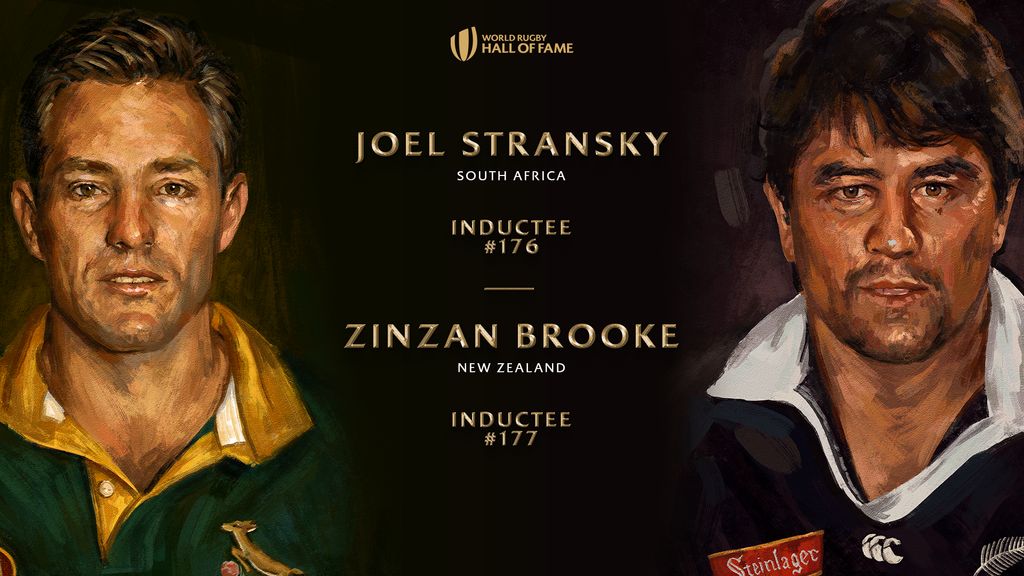
Joel Stransky and Zinzan Brooke are the first of seven modern greats to be inducted into the World Rugby Hall of Fame as the class of 2026.
The contributions of former Springbok fly-half Stransky and All Blacks number eight Brooke were celebrated at a special dinner in Cape Town on Thursday ahead of the second test of the Rugby’s Greatest Rivalry series between South Africa and New Zealand.
Both Rugby World Cup winners on home soil with New Zealand in 1987 and South Africa in 1995 respectively, Brooke and Stransky also faced each other in the last test series between their two nations 30 years ago.
Stransky kicked all of South Africa’s points in the 1995 final, including the extra-time drop goal that ensured his place in Springbok rugby folklore. The fly-half played 22 tests for South Africa from 1993-96, scoring six tries and 240 points in the green and gold jersey.
Former All Black Brooke, who famously kicked a drop goal in the RWC 1995 semi-final against England, was a player with genuine x-factor, combining the skills of a back with the power of a back row. He started 54 of his 58 tests for New Zealand across his 12-year international career.
The World Rugby Hall of Fame recognises those that have made an outstanding contribution to the game of rugby throughout their careers, while also demonstrating rugby’s character-building values of integrity, passion, solidarity, discipline and respect.
The remaining five members of the class of 2026 will be announced on Monday, 7 September and will take the number of inductees to 182 since the Hall of Fame began in 2006.
World Rugby Chair Brett Robinson said: “On behalf of the global rugby family, I would like to congratulate Joel and Zinzan, two players I had the privilege of playing against, on their richly deserved inductions into the World Rugby Hall of Fame.
“Joel’s name will forever be linked with one of rugby’s most powerful and unifying moments, his winning drop goal at Ellis Park in the Rugby World Cup 1995 final giving us the iconic image of Nelson Mandela in a Springbok jersey alongside captain Francois Pienaar as a nation came together.
"Zinzan, himself a Rugby World Cup winner in 1987, challenged what people thought a forward could be with his skill and imagination, from his commanding presence at number eight to that unforgettable drop goal from distance in 1995.
“I also look forward to welcoming the rest of the class of 2026 to the Hall of Fame.”
John Eales, Chairman of the Hall of Fame panel and a Hall of Fame inductee, said: “This year’s inductees represent the very best of our sport with extraordinary talent matched by humility, leadership and an unwavering commitment to rugby’s values. From World Cup-winning moments etched in history to the quiet, tireless work many have done to grow and champion the game long after their playing days, each of them has shaped rugby for the better. On behalf of the Hall of Fame, I warmly welcome them into the fold.”
For more information on the World Rugby Hall of Fame, visit www.world.rugby/halloffame.
World Rugby Hall of Fame 2026 inductees
No.176 – Joel Stransky (South Africa)
No.177 – Zinzan Brooke (New Zealand)
Joel Stransky (South Africa)
World Rugby Hall of Fame – Inductee No.176
Joel Stransky will forever be remembered as the player who kicked South Africa to their first-ever Rugby World Cup against New Zealand in 1995.
By then, Stransky was an established international, with the fabled final falling midway through his 22-test career, which began with a win against Australia in Sydney in July 1993.
Stransky scored the first of his six test tries in his second match in Springbok colours in the return fixture against the Wallabies in Brisbane, on his way to amassing 240 points in his three-year career at the highest level.
In the final of RWC 1995, the fly-half scored all of South Africa’s points in a 15-12 win at his home ground, Ellis Park, including the extra-time drop goal that ensured Stransky of his place in Springbok rugby folklore.
Stransky’s talent and dedication were apparent from an early age. By 20, he had become a key player for Natal. After helping Natal beat Northern Transvaal in 1990 to win the Currie Cup for the first time, the young Stransky spent two successful seasons in Italy representing L’Aquila and San Dona before returning home.
The arrival of professionalism took him overseas again, this time to England and Leicester, where he scored 896 points in 73 appearances for the Tigers, helping them to win both the Pilkington Cup and the Allied Dunbar Premiership title.
After a successful playing career and a brief foray into coaching, Stransky’s business acumen and natural leadership led him to become a successful entrepreneur. Sports marketing was a key focus initially, while he has enjoyed a two-decade long career as a television presenter, commentator and analyst.
Zinzan Brooke (New Zealand)
World Rugby Hall of Fame – Inductee No.177
Despite his first initial, Zinzan Valentine Brooke was a genuine X-factor player.
Once described by All Blacks team-mate Jeff Wilson as ‘a team in a number eight’s body’, Brooke had the skills of a back as well as possessing the dynamic power more normally associated with his position at the base of the scrum.
One of the few forwards from a leading rugby nation to have ever kicked a drop goal, Brooke is best remembered for a 38-metre effort against England in the semi-finals of Rugby World Cup 1995 and the historic series-clinching three-pointer a year later against the Springboks.
A Rugby World Cup winner at the age of 22 in 1987, Brooke appeared in three tournaments on his way to winning 58 caps for his country, 54 of them starts, in a test career spanning 12 years. His tally of 17 test tries was a record for a forward at the time.
Brooke represented the All Blacks 100 times in total, including 42 non-international matches, and played 22 times for the Māori All Blacks. He played alongside his younger brother Robin on many occasions for club and country, and as captain of the Auckland Blues, he led the team to back-to-back Super 12 titles in 1996 and 1997. A distinguished provincial career saw him play 140 games for Auckland where his flair and finesse saw him score an impressive 94 tries.
During his distinguished career, Zinzan Brooke also spent some time overseas, including a spell in Italy with Lazio and, as a player and then head coach, with Harlequins in England. After one season at Coventry in 2002/03, Brooke called time on his pro career.
Brooke’s impact in New Zealand’s sporting landscape was such that in 1997 he was appointed a Member of the New Zealand Order of Merit (NZOM) for services to rugby.
